A binational air quality monitoring project involving public agencies and nonprofits was recently announced by officials
The state Department of Public Health announced a binational air quality monitoring effort along with other public agencies and non-profit organizations that seek to provide tools and prevention activities to help residents protect against air pollution.
The program, named Proyecto Frontera or Border Project in English, seeks to improve the administration and outreaching among environmental protection agencies and organizations like Mexicali’s Hélice and Redspira, as well as the Imperial County Air Quality Control District and Comité Cívico del Valle.
Assistant Director of Health Néstor Hernández said the project seeks to determine the outstanding situation of air quality, while identifying the most polluted areas by providing training, setting a new manual to address environmental contingencies and the development of an oversight air quality tool.
The authorities also seek to update data related to illnesses impacted by air pollution like asthma, acute rhinopharyngitis, acute sinusitis, pharyngitis, bronchitis, and others, said Chief Epidemiologist Oscar Zazueta.
So far, the authorities have held several meetings in which over 30 participants have provided insight regarding this issue.
Also, the project has led to the signing of an agreement that includes activities to consolidate monitoring activities of air quality and public health, as well as the holding of two seminars from experts of Mexico’s National Public Health Institute.
Water cleaning effort discussed
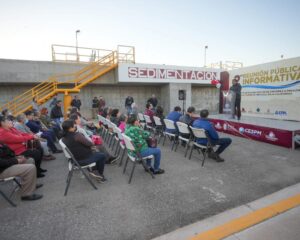
State and city officials met Wednesday in order to discuss for the second time a proposal that seeks to rehabilitate water emitters that belong to Mexicali’s water conveyance system.
The project seeks to replace damaged equipment in order to make sure residual waters are collected.
The water conveyance system improvement will help reduce gas concentration that causes corrosion in water delivery lines, while preventing raw water into the New River.
At the same time, the project will help keep urban areas free of wastewater seepage and protect public health.
The state Commission of Public Utilities of Mexicali requested non-reimbursable funds to the North American Development Bank to partially finance the rehabilitation effort. However, the project must first obtain a certification through public participation.
The project is expected to cost 115 million pesos or little over $6 million USD. Half of the funds will be provided by the new US, Mexico Canada Trade Agreement’s Border Environmental Infrastructure Fund. The state and Mexican governments will provide the other half of matching funds.
State Secretary of Water Management and Protection Armando Samaniego said the project will benefit over 700,000 Mexicali residents.
“By ensuring the efficient collection and evacuation of wastewater, through the replacement of emitter lines in the city, risks and damages to health due to diseases will be eliminated, mainly due to discharges of wastewater without treatment or with inadequate treatment and flows contaminated,” Sec. Samaniego said.
“However, the indirect benefit reaches each and every one of Baja Californians because contamination of aquifers such as the New River will be reduced, also avoiding the crossing of untreated wastewater to California.”
Te puede interesar: Lanza Salud alerta por contaminación